


 Find additional Shakespeareances
Antony and Cleopatra
The Beating Hearts Inside Shakespeare's Text
Synetic Theatre, Shakespeare Theatre Company's Klein Theatre, Washington, D.C.
Sunday, January 18, 2026, E–111 (Center Front Orchestra)
Directed by Paata Tsikurishvili
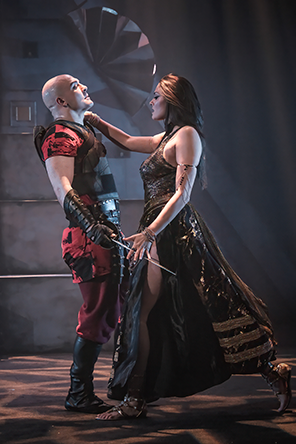
Vato Tsikurishvili as Antony (left) and Irina Kavsadze as Cleopatra begin their testy courtship in the Synetic Theatre production of Antony and Cleopatra at the Klein Theatre in Washington, D.C. Photo by Katerina Kato.
Synetic Theatre, entering its 25th season on the Washington, D.C., theater scene, established its place as premier purveyor of "Silent Shakespeare" productions with its debut staging of Hamlet…the rest is silence in 2001. The company would switch its tag line to "Wordless Shakespeare" as the more accurate descriptor because, aside from expunging The Bard's words, the company's Shakespearean stagings certainly are not silent. Being wordless is one fourth of the company's success. The other three fourths are elite dance and movement performances to masterful soundtracks that surface emotional and thematic dynamics of Shakespeare's plays that words, even Shakespeare's, can't reach.
The company accomplishes all of that in the 95-minute (no intermission) remount of its 2010 staging of Antony and Cleopatra at the Shakespeare Theatre Company's Klein Theatre in Washington, D.C., running through January 25 (it will be remounted again February 21–March 8, at The Thomas Jefferson Community Theatre in Arlington, Virginia). To be sure, this is not textual Shakespeare; this is Paata's Shakespeare, the imaginative product of Synetic's founding artistic director Paata Tsikurishvili, who helmed this and the original production. Resident Dramaturg Nathan Weinberger is credited as adaptor, as well.
In some of his wordless adaptations, Tsikurishvili stays generally true to Shakespeare's textual narrative, as he did with Hamlet, Twelfth Night, and A Midsummer Night's Dream. More often, he uses Shakespeare's text as a framework on which to hang his own telling of the story, as he does with Antony and Cleopatra.
This Antony and Cleopatra combines Shakespeare's version with Shakespeare's Julius Caesar and goes even further back in history by starting the play with Cleopatra's internecine battle for Egypt's throne against her brother, Ptolemy (Natan-Maël Gray). From the outset, Tsikurishvili puts Cleopatra's mystical spiritual essence at the forefront of her character, with Mardian (Stella Bunch), Shakespeare's eunuch in Cleopatra's court, presented as a masked high priestess/sorceress dressed in black and serving as a narrative engine. She's often accompanied by other all-in-black women, posing and dancing as hieroglyphic figures. Mardian engineers the delightful historical account of Cleopatra rolled up in a rug making her initial entry into the presence of Julius Caesar (Tony Amante).
Shakespeare 's Julius Caesar provides this play's assassination of Caesar and the Battle of Philippi. One key addition to the former is the presence of Octavian (founding company member Philip Fletcher). He doesn't take part in the assassination, but he watches the murder unfolding and hides from Caesar as the dying would-be emperor staggers toward him. The Battle of Philippi is one of a handful of battle scenes showing off the company's dance skills, athleticism, and pin-point choreography. Bodies literally fly across the stage, and swords clashing literally produce sparks. Three choreographers are credited for this exquisite mayhem: founding member and Paata's wife, Irina Tsikurishvili, as choreographer; Ben Cunis for original fight choreography; and Paata's and Irina's son Vato Tsikurishvili as remount fight choreographer.
By working Caesar's history with Cleopatra into Shakespeare's Antony and Cleopatra, this production provides a throughline portraying how the romantic relationship between Cleopatra (Irina Kavsadze) and Antony (Vato Tsikurishvili) evolves from their first meeting in Caesar's company through their mutual coronation as Egypt's monarchs to their deaths worthy of a Puccini opera. The first significant moment in the relationship comes when all of the Romans on stage, including Caesar, bow to the queen except the absent-minded Antony. Cleopatra standing nearby gives him such a fearsome look he can't help bending his knee.
The casting of Kavsadze and Vato is ingenious, lifting the visual sex-and-violence vehicle for the two lovers into a personality-driven drama of love and hate, power and despair, loyalty and treachery. These descriptive nouns are not paired as opposites; they are dualities in the hearts and souls of these two singularly historic figures and also in Antony's loyal sidekick, Enobarbus, played by Zana Gangkhuyag.
Kavsadze has been with Synetic since 2004, starting out in the Synetic Teen Company. She’s grown up through a series of leading characters, including A Midsummer Night's Dream's Hermia, The Tempest's Miranda, Titus Andronicus's Lavinia, and Romeo's Juliet. She is an erotically sexy Cleopatra as well as being wily and physically powerful: she fights with the best of them, including Antony as their physical scuffle turns into foreplay. Long a centerpiece dancer for the company, Kavsadze gets yet another suitable opportunity to display her range of physical talents playing Cleopatra, but she also brings the presence necessary for portraying the scheming mind and fissured heart of Egypt's emotionally wracked queen navigating a world dominated by egotistical men. She displays the intelligence and guts to outlast them all, even in death: after succumbing to the self-inflicted bite of a large asp, this Cleopatra literally outshines the would-be triumphant Octavian.
I did quadruple takes when I saw Vato Tsikurishvili cast as Antony. He is not the youthfully physical specimen one might associate with Antony in this company of physically virile male specimens. He’s a bit doughy, he's not young, and he has the face of Frankenstein’s Creature. None of these descriptions are meant to be insulting: I’m more than a bit doughy and long past young, and Vato played Frankenstein’s Creature for Synetic. He’s also played Quasimodo, and his Shakespeare roles follow an obvious trend: The Tempest’s Caliban, Taming of the Shrew’s Hortensio, As You Like It’s Sylvius, Dream’s Snout, and Osric and the Gravedigger in Hamlet. All those are comically oddball characterizations, which is one of the dimensions that go into his portrayal of Antony. He starts as the simply loyal and smart soldier and becomes a political leader contending with the empire’s internal upheavals while stumbling into his own midlife emotional crisis. He’s firmly macho at times, he’s confoundedly helpless at times, he’s clearly befuddled at times, he is utterly authoritative at times, and he holds tight to his values and stout loyalty at all times. That loyalty becomes his undoing in dealing with Octavian and, to a degree, with Cleopatra, too.
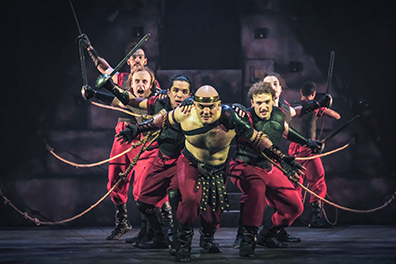
And don’t let his “doughy” look fool you: he’s as strong and agile a dancer and fighter as anybody on the stage while his acting skills shine through even as he’s traversing the Klein Theatre stage in two leaps with a lethal sword. One of the most incredibly executed choreographies I’ve seen in my 50 years of attending theatrical productions comes during the Egyptian's battle with the invading Romans. Antony and Enobarbus are on opposite sides of the stage, each sword fighting a Roman. Enobarbus suddenly and seemingly flies across the stage as Antony kneels down to make himself a vaulting horse that Enobarbus uses to catapult into a dramatic kill of the Roman with whom Antony had been dueling. I hope I described that correctly; it happened so fast. Besides, the winking look the two share after the stunt’s execution provides the true exclamation point.
Enobarbus, one of my favorite characters in Shakespeare's canon, is a narrative glue for the play. In addition to being Antony’s loyal lieutenant and confidant, he is tight with the members of the Egyptian court, including gaining Cleopatra’s trust. In the party on the barge with Octavian and Antony as guests of one-time rebel Pompey (Rodin Alcerro), Enobarbus shares friendships among all the factions present. Gankhuyag gets his solo spotlight as a dancer in this scene—per Shakespeare, Enobarbus proposes to dance "the Eyptian Bacchanals and celebrate our drink"—and he combines elegance and athleticism with an ever-present smile.
His moment of losing faith in his general comes in a surprising but effective manner after the above-mentioned battle between the Egyptians and Romans. Seeing so many of his former Roman legion friends dead on the stage, Gankhuyag's Enobarbus looks into the faces of a few and despairs at what he's done, what his world has come to, what his commander and best friend has become. As Antony tries to congratulate his old friend, Enobarbus turns his back and joins with Octavian. In the next battle when the Romans overwhelm the Egyptian army, Enobarbus has Antony at the point of his blade. With the two alone on the stage, Antony in despairing realization surrenders his life to his longtime friend, who instead turns his sword on himself.
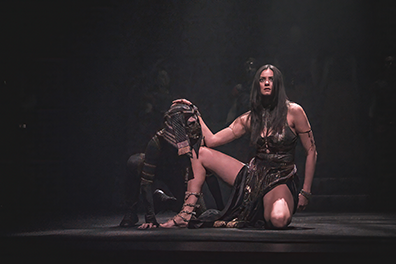
Above, Mardian (Stella Bunch, left) advises Cleopatra (Irina Kavsadze) as the Egyptian queen navigates the Romans' intentions with her domain. Below, Antony (Vato Tsikurishvili, center) captains his Egyptian galley into battle comprising, from left, Tony Amante, Joshua Cole Lucas, Liam Klopfenstein, Natan Maël-Gray, Ernest Fleischer, and Rodin Alcerro. Photos by Katerina Kato.
Shakespeare's version of Enobarbus's death is anticlimactic, perhaps an intentional thematic thrust at how Antony's and Cleopatra's have-everything lives come to utter, even trivialized ruin. Paata's version may have fewer dramatic dimensions than Shakespeare's, but this moment packs a greater emotional wallop, and that's in large part due to the heart with which Vato and Gankhuyag play their characters. By the way, these two actor dancers have played a duo before with Synetic: Vato as Dogberry and Gankhuyag as Verges in Much Ado About Nothing.
Sex and violence is a given for a play titled Antony and Cleopatra featuring the collision between the warrior order of the Roman Empire and the seductive exotica of Dynastic Egypt. As this production takes the violence to acrobatic extremes, it also turns the sex into puerile obsession. Visual sexual inuendo runs rampant, including a dance interlude—I should say lap dance—as Fletcher's Octavian and a servant woman perform quite the sex scene on a chair. Their multiple copulations are hidden to the audience by the chair's tall back, so all we see are the couple's hands and legs at various angles and Fletcher's exuberant and then exhausted face. However discomforting this may make some audience members, it is quite a display of contortionist talent by the two dancers.
Another hallmark of Synetic's "Wordless Shakespeare" brand are the aural and visual qualities of its productions. Technical Director and Scenic and Props Designer Phil Charlwood's set is a series of old-stone steps forming a pyramid at the back of the stage, which serves as the Egyptian throne and the Roman Senate House. Several battles are waged on those steps, too. Lighting Designer Colin K. Bills triplicates the set's pyramid motif with angled strands of spotlights forming pyramids from the ceiling. Bills' lighting fulfills many thematic purposes, from swaths of color palettes representing Roman and Egyptian scenes to a palpable sense of danger lurking in the shadows. It also serves as a practical tool for the production's continuous pace, using isolated spots to start scenes at the front or to one side on an otherwise blackout stage where sets and props are transitioning. Additional kudos, then, to Susanna Cai, the light programmer and board operator.
Then there's the music by Synetic's resident composer, Koki Lortkipanidze, who also serves as sound designer. A versatile musician as well as composer, he produces dynamic soundtracks ranging from ragtime (Twelfth Night) and early '60s rock and blues (Much Ado About Nothing) to playing abstract piano licks under the hood of an abandoned car (As You Like It). For Antony and Cleopatra, Lortkipanidze uses an orchestral soundscape of acoustic and electric strings and synthesizers with a heavy dose of percussion. It's by turns romantic and bombastic and always stirringly tuneful.
Which sums up this production of Antony and Cleopatra. Expanding on Shakespeare's framework, Synetic's version fully captures the beating hearts of the titular characters, the elder pair of the world's two greatest love stories that flowed from Shakespeare's pen and have been further endowed through Synetic's imaginary forces.
Eric Minton
January 24, 2026
Comment: e-mail editorial@shakespeareances.com
Start a discussion in the Bardroom
